Castle Hill
My PolicemanCastle Hill, reached on a school outing from Woodingdean, is both a striking landscape above Brighton and the setting of a decisive change in Marion Taylor’s understanding of Tom Burgess and Patrick Hazlewood. The hill first offers her an expansive view of the countryside surrounding the town where she has lived all her life. Later, during lunch among the gorse, Julia Harcourt asks whether Patrick is homosexual. Marion cannot return to her earlier way of avoiding the possibility: the word has been spoken, and Castle Hill becomes the place where suppressed knowledge begins to demand acknowledgment.
Setting and the school outing
In early summer 1958, Julia proposes that their classes take a nature trip to Woodingdean. The head agrees to a Friday afternoon outing, and the teachers plan to travel by bus before walking to Castle Hill. The children spend the week drawing plants and wildlife they hope to see, including hares, larks and gorse, and learning the spellings of bugle, orchid and primrose. Marion’s preparation owes something to the plants and landscapes Patrick had pointed out during walks with her and Tom on the Isle of Wight: the trip to Castle Hill is already linked, for her, to the knowledge and attention she associates with Patrick.
The party leaves school at about half past eleven, the children carrying packed lunches. Julia leads the line and Marion brings up the rear. The day is warm and windy, and the bus passes over the racecourse towards Woodingdean. On the way, Milly Oliver is sick, Bobby Blakemore sits at the back and sticks out his tongue at passing cars, and Alice Rumbold talks about her brother’s new motorbike despite Julia’s attempts to hush her. As the bus leaves town, most of the children fall quiet to watch the hills and sea come into view. Castle Hill is reached not in isolation but as the culmination of a shared school excursion, with its small practical disruptions and the children’s anticipation forming part of Marion’s recollection.
The view and the lunch
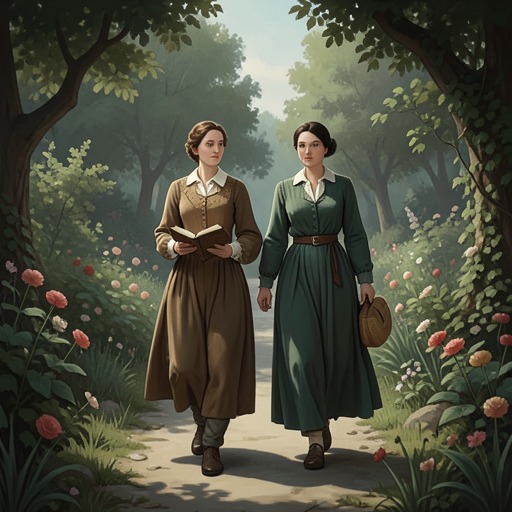
After leaving the bus on the outskirts of the village, the group crosses the downs behind Julia. Marion remembers Julia’s energetic manner, her twill trousers, light pullover and sturdy shoes, and the bright orange beads and tortoiseshell-framed sunglasses that stand out against her practical clothes. Julia’s attentiveness to the children is physical as well as verbal: she pats shoulders, guides them with a hand on their backs and kneels to speak at their level. Marion contrasts this ease with her own reserve as a teacher, making the walk a lesson in how to approach the children as well as a change of scenery.
The route drops out of the wind to a place from which the valley can be seen. Although Brighton has always been Marion’s home, she has not understood how fully this landscape surrounds it. The treeless hills reveal rather than diminish the curves of the downs, whose colours range from purplish brown to grasshopper green. Larks call overhead; buttercups speckle the grass; far below, the sea catches the light in white sparks. With her cardigan left behind in the classroom, Marion stands in a pink blouse and lets the sun warm her bare arms. The openness of the view gives her a new sense of the landscape around her familiar town.
At lunch, Julia and Marion sit a little apart from the children, still watching over them. Thick, prickly clumps of gorse surround the group and give off a coconut-like scent that makes the stop feel briefly like a holiday. After Marion finishes her egg-and-cress sandwiches, Julia offers smoked salmon. Marion has never tasted it; she finds it intensely salty, reminiscent of the sea, but also oily and mellow, and likes it at once. The food, the coastal view and the holiday atmosphere set the scene for a conversation that abruptly changes the meaning of the outing.
The conversation that changes the place
Julia first asks about Marion’s honeymoon on the Isle of Wight. Marion calls it lovely, then explains that the couple stayed in a cottage belonging to Tom’s friend Patrick, who had been best man at their wedding. Julia studies Marion’s face and asks further questions. Having noticed Marion’s confusion at her suggestion that Patrick is “comme ça,” Julia leans closer and asks whether he is homosexual. The remark is made while they are sitting over lunch, within earshot of the children; Marion remembers thinking Julia’s voice was not nearly low enough.
Marion’s reaction is immediate and bodily. The smoked salmon in her mouth seems to turn rancid, and she struggles to believe that Julia has said the word with such apparent casualness. Julia softens her question, allowing that she may be wrong, but Marion ends the exchange by standing and saying that the party should get going. She claps her hands and orders the children to stand. Julia leads them down the hill, identifying birds and plants along the way, while Marion cannot look at her or at the surroundings and fixes her attention on her own feet moving through the grass. The familiar duties of the trip continue, but Marion’s attention has shifted inward.
Retrospective significance
In her later account, Marion says she had not been entirely without suspicions before Castle Hill. She had tried to press the possibility out of her mind, with little understanding of gay life beyond newspaper stories about men charged with gross indecency or accused of “unnatural acts.” Such reports appeared often enough to seem almost ordinary, yet their regularity did not give her a way to face what they might mean for her own marriage. She recalls that Sylvie had earlier told her Tom was not like that, and that she had also seen Tom and Patrick standing together outside Osborne House. In the moment, however, those signs did not add up to an admissible conclusion.
Castle Hill is therefore not the beginning of Marion’s suspicion so much as the point at which evasion becomes harder to sustain. Julia’s question does not settle every uncertainty, but it changes the terms in which Marion can think about Patrick and, through him, Tom. On the walk home, she prepares to raise the matter with her husband, telling herself that he can deny it and that they can then carry on as before. Yet she cannot imagine what she will say beyond the opening words about Julia having said something awful about Patrick. The landscape that had widened Marion’s view of Brighton is paired with a new, unwelcome widening of her understanding: after the word is spoken at Castle Hill, she can no longer keep the possibility outside her thoughts.